After three years of war, Sudan’s civilians need stronger support
Expert comment
jon.wallace
20 April 2026
The devastating war in Sudan shows no signs of abating. Diplomatic efforts must prioritize a Sudanese-led political process.
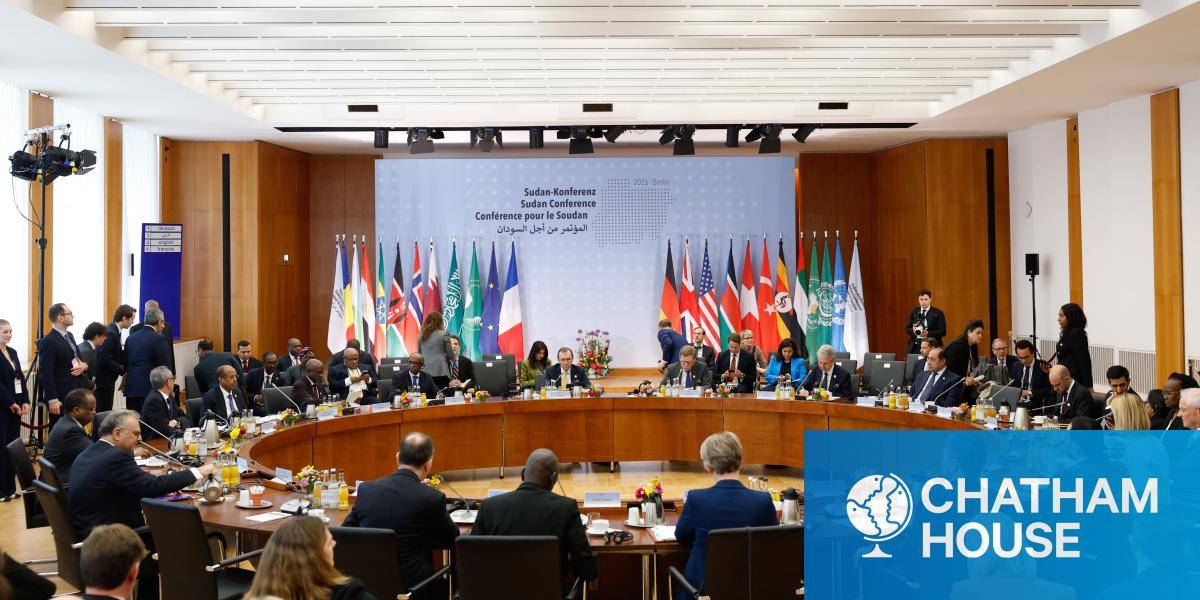
The brutal war in Sudan is now moving into its fourth year, with little prospect of resolution for the world’s worst humanitarian crisis. In the wake of the latest International Sudan Conference, held in Berlin on 15 April, the imperative remains to build a credible framework for an inclusive political process led by Sudanese civilians, and to strengthen channels between existing mediation structures. A regionalized war dividing the countryOn the battlefield, the main belligerents – the Sudanese Armed Forces (SAF) led by General Abdel-Fatah al-Burhan, and the Rapid Support Forces (RSF), under the command of General Mohamed Hamdan Dagalo (Hemedti), along with their respective coalitions – remain focused on a military victory. Control of Sudan is divided, with the SAF holding authority over the north and east of the country and the RSF largely in command of the west. The key battlefronts have continued to shift, with fighting now concentrated in the country’s centre and southeast: in the three Kordofan states as well as Blue and White Nile.There is no sign that either side can fully defeat the other, nor that a stalemate is close. Instead, both will likely seek further gains before the rainy season (June to September) makes territorial advances difficult. However, the rains will provide little respite for civilians, who continue to be indiscriminately targeted as both sides intensify the use of externally procured drones against civilian infrastructure.
Related work
Sudan’s volunteer-led aid network receives 2025 Chatham House Prize
Regional interests in the Middle East, Horn of Africa and Red Sea continue to exert influence on Sudan’s conflicting parties. The consolidation of competing regional alliances is obstructing meaningful progress, further complicating a fragmented diplomatic response.Competition among regional interests in Sudan’s conflict has been notably evidenced by assertive Saudi efforts to curtail the influence of the United Arab Emirates (UAE) since the start of 2026. More broadly, Saudi Arabia, Egypt, Turkey and Qatar have grown closer, with signs of alignment between the UAE and Israel, notably in Somaliland. These partnerships are often compartmentalized, with countries increasingly multi-aligned – presenting as allies on one issue and adversaries on another.A convoluted diplomatic landscape Given such complexity, diplomatic progress towards a ceasefire has been limited, while wider efforts to support a credible political process remain convoluted. Sudan has a Troika, a Quad and a Quintet – but these diplomatic groupings suffer from a lack of coordination. The Quad mediation mechanism – the US, Egypt, Saudi Arabia and the UAE – gained traction in mid-2025 in attempts to secure a ceasefire, but offers limited promise. Ostensibly, this platform seeks to navigate the differences between the Arab countries backing Sudan’s warring parties and to generate collective leverage to pressure the belligerents to end the war. However, the Quad has not made progress on stopping external military, financial and political support to them.
To be effective, any Quintet-supported process needs to coordinate with the Quad, Troika and other mediating stakeholders, under one coherent umbrella.
Nevertheless, the principles agreed by the Quad in 2025 give it ongoing significance. These include recognition that there is no viable military solution to the conflict; securing a humanitarian truce followed by a permanent ceasefire; a commitment to protect civilians; and support for an inclusive Sudanese transition to establish an independent civilian-led government that is not controlled by any warring party. President Donald Trump’s Senior Advisor for African Affairs, Massad Boulos, has been working to deliver a humanitarian truce, starting with demilitarization in El Fasher and parts of Kordofan, and the safe return of civilians, supported by a UN oversight mechanism. But there are major obstacles, including SAF’s insistence that the RSF withdraw from urban areas it controls and disarm in advance of truce talks. Such concessions are unimaginable, given the current military balance. They are compounded by the absence of high-level regional diplomacy, which is paramount if the belligerents are to accept a truce. War in the Middle East has partially diverted the attention of the Quad’s Arab members away from Sudan. Outcomes of the Berlin conference The third International Sudan Conference (co-hosted by Germany, UK, US, EU and AU), marks the latest effort to rouse international attention on Sudan. Expectations were modest – the summit was never likely to deliver a ceasefire. The ministerial session had to settle for a co-chair’s statement rather than a joint communiqué, repeating the lack of consensus at last year’s London Conference.
Related work
Why ending the war in Sudan should be a higher priority for the West
Berlin was primarily an opportunity for concerted international action that reaffirms support for an end to the war. The conference secured vital humanitarian commitments of over €1.5 billion – the EU and its member states pledging €764 million and the UK €165 million. But it must also mark a turning point for more effective coordination.One of the main aims of Berlin was to centre non-aligned Sudanese civilians, highlighting their perspectives on ending the war and restoring a civilian-led political dispensation. This stands in sharp contrast to criticism of the conference by Sudan’s SAF aligned de-facto government and objections by the RSF’s Tasis coalition.The summit included a civilian political seminar organized by the multilateral Quintet bloc (AU, EU, Intergovernmental Authority on Development, League of Arab States and UN), supported by Germany. An important outcome was a joint declaration calling for an end to the war and the advancement of a Sudanese-owned political process leading to civilian leadership.Empowering Sudan’s civilian political processSudan urgently needs a credible and inclusive political process, supported by coherent international facilitation. Previous efforts to advance a framework have not materialized, due to deep divisions between Sudanese political blocs and an incoherent approach by the African Union. The Quintet’s support for an inter-Sudanese political dialogue should be encouraged. This process should be grounded in broad-based civilian participation – with non-aligned democratic actors at the forefront. It should not be controlled by the warring parties, although including elements within their coalitions is essential, provided they seek peace and civilian rule. This linkage is critical to shift incentives away from militarized actors and toward a negotiated transition. It is also a crucial step in providing Sudanese civilians with a platform to pressure the SAF and RSF to end the war. To be effective, any Quintet-supported process needs to coordinate with the Quad, Troika and other mediating stakeholders, under one coherent umbrella. The Troika states (US, UK and Norway) have been important mediating actors in Sudan and South Sudan for over two decades. The UK and Norway are aligning efforts to expand dialogue and trust among civilian groups. To be effective, the outcomes of such dialogues should be channelled through the Quintet process, via a coordinating mechanism. Read More






Leave a Reply